Menopause Joint Pain: Why Resting It Makes It Worse
Tell me if this sounds familiar.
You swing your legs out of bed and your feet don't want to take your weight for the first few steps. Your hands are stiff until about ten o'clock. Your knees have started announcing themselves on the stairs. Nothing happened. You didn't fall, you didn't pull anything. It just crept in.
So you land on one of two conclusions. Either "I'm getting old", or "I must have arthritis". And you stop. You drop the class, you cut the walks short, you stay off the knee. Because that's what you do with a sore joint, isn't it.
Here's the bit I need you to hear. Joint pain is a menopause symptom. A proper, common, documented one. And resting it is very often what makes the next six months worse.
It's the symptom I see misunderstood more than any other at the studio, and the research on exercise for menopause joint pain points the opposite way to most people's instinct.
In this guide
Why everything aches in perimenopause
Oestrogen doesn't only deal with your periods. There are oestrogen receptors in your cartilage, your tendons, the lining of your joints and your muscle itself, where it keeps inflammation in check and helps those tissues stay springy and well behaved.
So when it starts swinging about through perimenopause and then drops away, those tissues notice. Inflammation sits higher. Tendons get less tolerant. Joints feel tight first thing. Muscle gets harder to hold on to, which matters more than it sounds.
This has only recently been given a proper name. In 2024, researchers writing in the journal Climacteric grouped it together as the musculoskeletal syndrome of menopause, and reported that around 70% of women experience musculoskeletal symptoms through the transition, with roughly a quarter affected badly enough that it limits what they can do. Seven in ten isn't a handful of unlucky women.
Menopause aches have a shape to them, and women describe it to me almost word for word:
- Worst first thing in the morning, better once you've been up and about
- It moves around. Hands one month, hips the next, then a shoulder
- Often both sides at once, rather than one dodgy knee
- Hands, knees, shoulders, hips and feet are the usual suspects
- Stiffness as much as pain, and it's worse the longer you sit still
If you've been told it's just wear and tear, I'd gently push back on that. Wear and tear doesn't normally turn up in five joints at once in the same eighteen months.
The rest trap
Now the bit that costs women the most, and it's so reasonable nobody questions it.
Your knee hurts, so you stop loading your knee. Except the muscle around that knee is what takes load off the joint itself, and muscle you stop using goes away. It goes faster in your late 40s and 50s than it did in your 30s, because the hormonal backdrop is already working against you.
Weaker leg, so more of every step goes through the joint instead of the muscle. Which hurts. So you rest it a bit more. Three months later you're weaker, stiffer, sorer and thoroughly convinced your body is falling apart.
Rest is the right answer for an ankle you went over on last Tuesday. It's the wrong answer for an ache that's been quietly there since February.
The joint itself doesn't help matters. Cartilage has no blood supply of its own. It gets what it needs from the fluid inside the joint, and that fluid only really moves about when the joint moves and takes load. A joint that does nothing is a joint being under-fed.
None of which is me telling you to push through pain and hammer yourself. I've written a whole post on the opposite problem, because over-exercising in midlife backfires too. There's a sensible middle and almost nobody is standing in it. Most women I meet are either doing nothing because it hurts, or flogging themselves in classes their joints can't currently cope with.
What HRT and supplements will and won't do
Two things everybody asks about before we get to the training.
HRT. Plenty of women tell me their aches improved on it, and I'm not about to argue with their own bodies. But I'd rather you went in with realistic expectations than came off it disappointed in three months. The trial evidence for joint pain specifically is modest. In the oestrogen-only arm of the Women's Health Initiative, the women taking oestrogen reported joint pain only a few percentage points less often than the women on placebo after a year. Real, measurable, a long way short of a cure.
HRT is still worth a proper conversation with your GP, for all the reasons it's worth having. I've covered how it sits alongside training in my guide to HRT and exercise. Just don't park your joints while you wait for it to work.
Supplements. Collagen, turmeric, glucosamine, joint complex blends at thirty quid a tub. I'm not going to claim none of them do anything for anyone. I will tell you that nothing in a pot comes close to the quality of evidence strength training has for this exact symptom, and most of them cost more per month than training does. My honest read on the ones that do hold up for women our age is in my piece on protein and creatine for women over 40. The list is short, and it's cheap.
Why strength training is the best exercise for menopause joint pain
This sounds wrong the first time you hear it, so here's the mechanism rather than me just asking you to trust it.
Muscle is your joint's shock absorber. Stronger quads, glutes and hamstrings mean your knee gets cushioned rather than crunched on every stair and every kerb. Same at the shoulder and the hip. You can't make the cartilage younger. You can absolutely change how much work it's asked to do.
Tendons rebuild when you use them. Tendon tissue remodels under load, slowly, over weeks, and does nothing useful while you sit still. Those cranky midlife tendons at the shoulder, elbow and hip generally improve with gradual loading and get worse with avoidance.
And it has randomised evidence behind it. Resistance training two or three times a week has better trial support for midlife joint pain than any supplement on the shelf, and it brings the bone density and muscle benefits with it. One thing to do, several problems handled.
The full case for picking up weights in midlife is in strength training for women over 40. This post is about doing it when it already hurts.
How we actually train an aching body
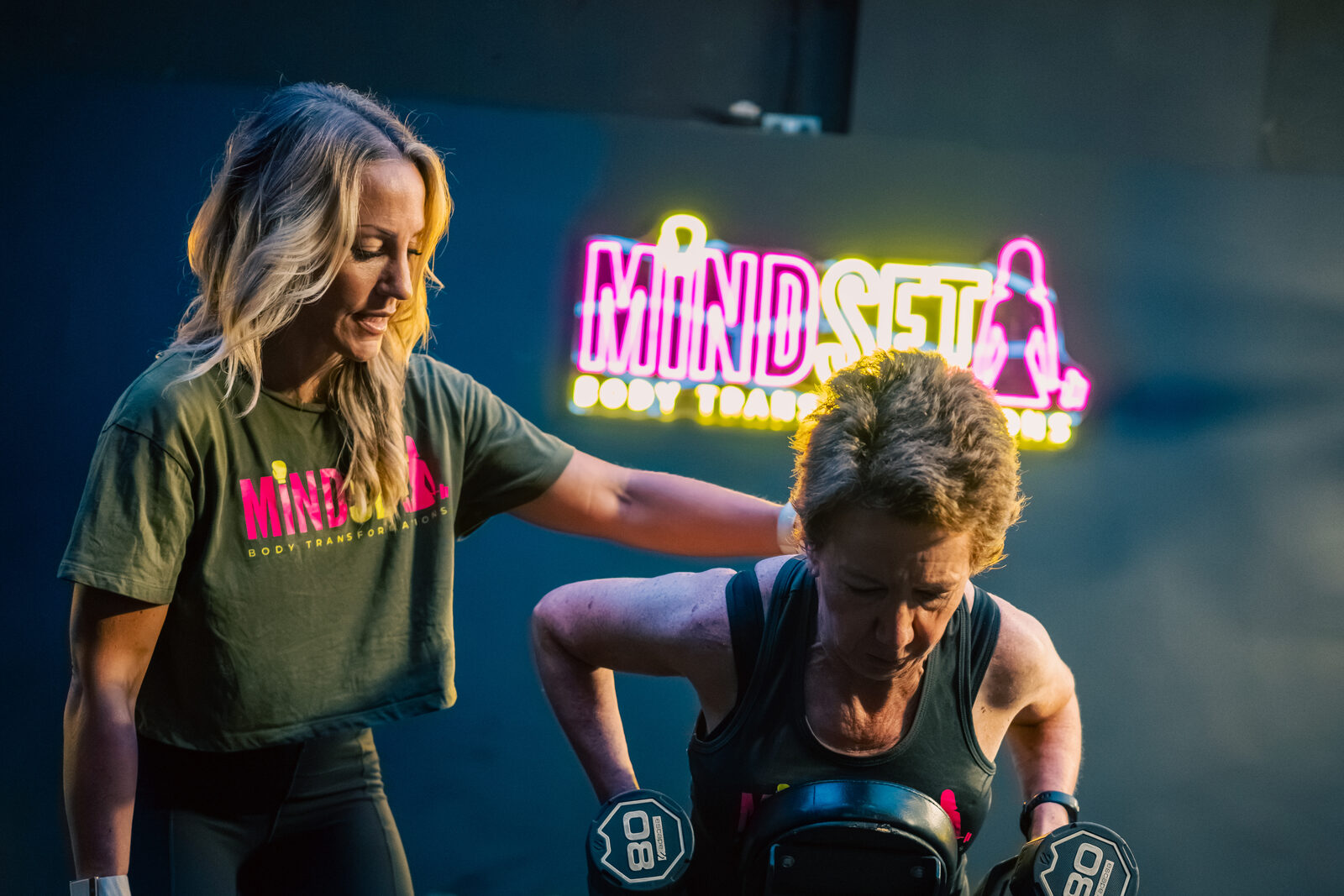
Right, the practical bit. This is roughly what I'd do with you if you walked in on Monday with sore knees and hands you can't make a fist with before lunch.
Start lower than you think, then build. Not "take it easy forever". Start at a weight that's comfortable, prove the joint is happy, then add. Start too heavy and you flare up and quit. Start light and never add anything and you get nothing. The skill is all in the adding.
Find the range that doesn't hurt, and own it. If a full squat hurts your knee but a half squat doesn't, we do half squats. Properly, with load. Over a few weeks that range usually widens on its own.
Swap, don't skip. Almost nothing gets binned, it just gets changed:
- Sore knees: box squats and split squats instead of deep squats, step-ups and sled pushes instead of anything that jumps
- Sore wrists or hands: dumbbells and neutral grips instead of a barbell, and straps so your grip isn't the weak link
- Sore shoulder: press on an incline rather than dead overhead, and keep the pulling work in, because the back work usually helps the shoulder
- Sore hips: shorter range, feet a bit wider, more glute work than feels necessary
Slow the reps down. Three seconds down, controlled back up. Tempo gives tendons the time under load they respond to, and you get a proper session out of a weight that doesn't aggravate anything.
Use the 24 hour rule. This is the one I'd tattoo on people. A dull ache during a session that's gone by the next morning is normal, carry on. Sharp pain, swelling, or a joint noticeably worse the next day means it was too much. Back off the load, not the training.
Warm up for longer than you used to. Ten minutes, not two. At 48 your joints want more notice than they did at 28. And move first thing at home too, even for five minutes, because morning stiffness responds to movement far better than it responds to waiting it out on the sofa.
Twice a week is the dose. Two proper strength sessions a week, every week, for three months. That's what changes a joint. Not a heroic fortnight in January. If you've been out of it a while, my guide to starting exercise again after 40 covers those first few weeks.
And the honest reason I bang on about small groups. That's a lot of decisions. Which swap, how much load, whether that ache is the normal kind. Nobody gets those right off a YouTube video with a knee that's already talking to them.
When it isn't the menopause
I'm a coach, not a doctor, and this is the part where I want you to go and see one.
"It's probably the menopause" has been used to wave away far too many women in their 40s and 50s, and sometimes it's covering something else. Rheumatoid arthritis very often starts in exactly this age bracket. So does an underactive thyroid. Vitamin D runs low in a lot of us by a British February. Get it looked at rather than assuming, particularly with any of these:
- One joint that's hot, red or visibly swollen
- Swelling in the small joints of both hands, with morning stiffness lasting well over an hour
- Joint pain alongside a rash, a fever, or weight loss you can't explain
- Pain that wakes you every night, or pain getting steadily worse rather than moving around
None of that means you can't train. It means somebody should know what they're treating first. Take this list with you if it helps.
Your questions, answered honestly
Is joint pain a symptom of menopause?
Yes, and it's one of the least discussed. In 2024 researchers writing in the journal Climacteric gave it a name, the musculoskeletal syndrome of menopause, and reported that around 70% of women experience musculoskeletal symptoms through the transition. Oestrogen has an anti-inflammatory role in joints, tendons and muscle, so when it falls away, a lot of women ache.
How long does menopause joint pain last?
For most women it's worst through perimenopause and the first few years after their last period, then it settles. That can still mean several years, which is why waiting it out is a poor plan. What you do in the meantime matters, because muscle lost during those years doesn't come back on its own.
Does exercise make menopause joint pain worse?
The wrong exercise can. Jumping straight back into running or high-impact classes you haven't built up to will usually flare an aching joint. Sensible strength training does the opposite. Use the 24 hour rule: a dull ache that's settled by the next morning is fine, while pain that's sharp, swollen or worse the following day means the load was too much.
What exercises should I avoid with menopause joint pain?
Fewer than you'd think, because most things get swapped rather than dropped. Sore knees: box squats and split squats instead of deep squats, step-ups instead of running. Sore wrists or hands: dumbbells with a neutral grip rather than a barbell. Sore shoulder: press at an angle rather than straight overhead. The aim is to keep loading the joint in a range that doesn't hurt, then widen that range.
Is it menopause joint pain or arthritis?
You can't tell from a blog post, and nor can I from across a gym floor. Menopause aches tend to move around the body, feel worst first thing, and ease once you get going. See your GP about one hot, swollen joint, swelling in the small joints of both hands with morning stiffness lasting well over an hour, joint pain with a rash, fever or unexplained weight loss, or pain that wakes you every night. Rheumatoid arthritis often starts in this age bracket and is regularly waved away as menopause.
If you take one thing from this, make it this. The ache is real, it has a name now, and it isn't a sign your body is finished. The tissue holding you together has lost support it used to get for free, and needs you to supply it another way. Which, inconveniently, means doing the thing that feels backwards when you're sore.
I've watched women come in barely able to get off a bench without pushing up with their hands, and six months later they're loading a trap bar and the stairs have stopped being an event. Not because the menopause finished. Because they got strong enough to carry themselves through it. 💜
Come and try it. Properly.
Start with a completely free 7-day trial. No contracts. No pressure. No awkward sales pitch. Just 7 days to meet the coaches, get to know the ladies, and feel for yourself what makes this place different.
Start Your Transformation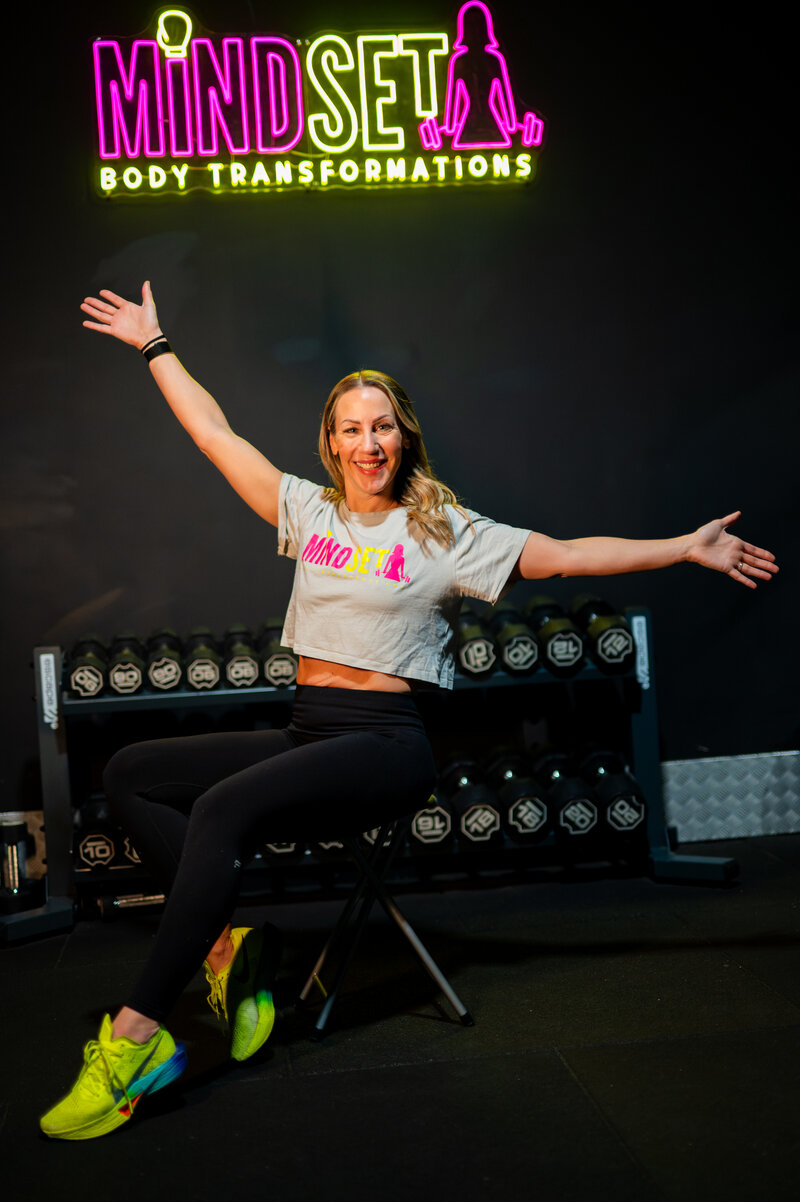
Written by Carrie
I'm the founder and head coach at Mindset Body Transformations in Southampton. I've spent the last 7 years helping women over 30 feel stronger, healthier and a lot more like themselves again. More about me.
Quick honest note: this is general advice from a coach, written to help you understand your body, not medical advice. Joint pain has a lot of possible causes and menopause is only one of them. If you've got a joint that's hot, swollen or getting worse, or you're thinking about HRT or supplements, please have a chat with your GP or pharmacist first.